
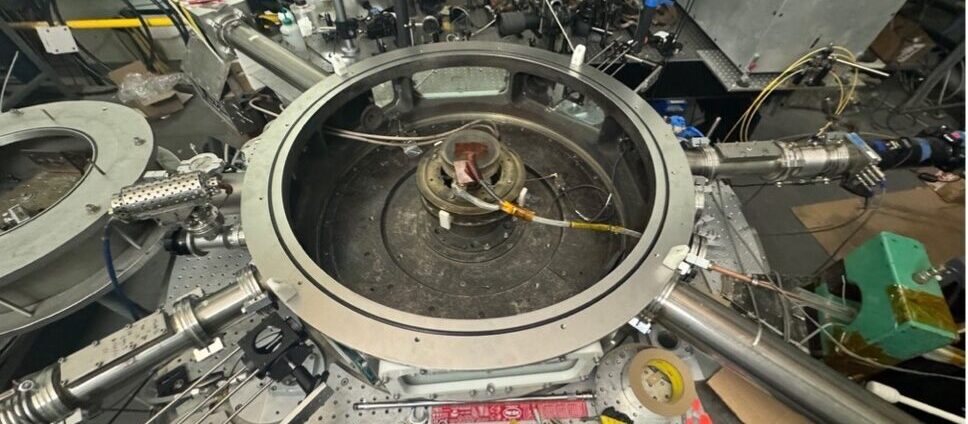

Gas-puffs are a Z-pinch load configuration that facilitate repetition rate and allow for a low load mass suitable for 1-MA class pulsed power drivers. One challenge with gas puffs, however, is the control of instability growth during the implosion phase. Notably, the Magneto Rayleigh-Taylor Instability (MRTI), caused by the acceleration of the load by the vacuum magnetic field, is particularly detrimental. Simulations done by Narkis et al. [1] found that MRTI growth does not vary monotonically with atomic number of the outer liner gas species in triple nozzle gas-puff Z-pinches. They observed increased stability with an Ar outer liner compared to Ne and Kr, which was attributed to the higher effective electron adiabatic index in Ar and lower radiative cooling loses. Experiments were conducted on the 1-MA, 220-ns rise-time COBRA Marx bank at Cornell University through the ZNetUS program to serve as the experimental companion to those simulations.
A gas puff load consisting of two liners around a H2 target doped with small amounts of Xe was fielded. The outer liner material varied between Ne, Ar, and Kr. The inner liner remained constant as Ne. The Kr liner was the most unstable, with instability amplitudes up to 1.6 ± 0.1 mm at stagnation while Ar had 1.3 ± 0.1 mm and Ne had 1.5 ± 0.2 mm. The Ne case had the strongest X-ray emission with a relative yield of 273.8 ± 65.7 V*ns compared to 153.6 ± 92.8 V*ns for Ar and 91.3 ± 26.4 V*ns for Kr. Time integrated X-ray spectroscopy showed the highest temperatures in the Ne case, reaching ~195 eV compared to ~120 eV in Ar and Kr. With the addition of an axial magnetic field to the Ne case, the growth of the MRTI was effectively mitigated and instability amplitudes dropped below 1 mm at stagnation; however, this led to reduced yields. Additionally, XUV and visible framing camera images show a helical structure in the non-magnetized case that is not present in the magnetized case. With FLASH, we performed ad hoc injection simulations that incorporated the injector geometry to initialize the density profiles of the different liners. This approach reduces the number of free parameters and enables more meaningful comparisons with experimental results. Overall, the stability hierarchy seen experimentally was retrieved from FLASH by looking at the MRTI growth rates of the three outer liner configurations. These results facilitate information on the understanding of gas puff Z-pinch dynamics and radiation as a function of density profiling, liner species, and an external magnetic field. These experiments were led by two Ph.D. students Oren Yang and Kimberly Inzunza. The work is being prepared for publication in top physics journal.
This work is conducted under the auspices of the DOE NNSA award numbers DE-NA0004147, DE-NA0004200, and DE-NA0004148
References
[1] J. Narkis et al., Phys. Rev. E. 105, 045205, (2022).